Real questions
A benchmark written the way players ask, in Reddit and Google phrasing, written before any answer is seen. Each game also has its own golden set.
 Checkpoint
In private beta
It’s dangerous to go alone. Take this.
Checkpoint is a research system, not a chatbot. It builds a structured knowledge base for each game, keeps it in step with each patch, and shows its sources on every answer.
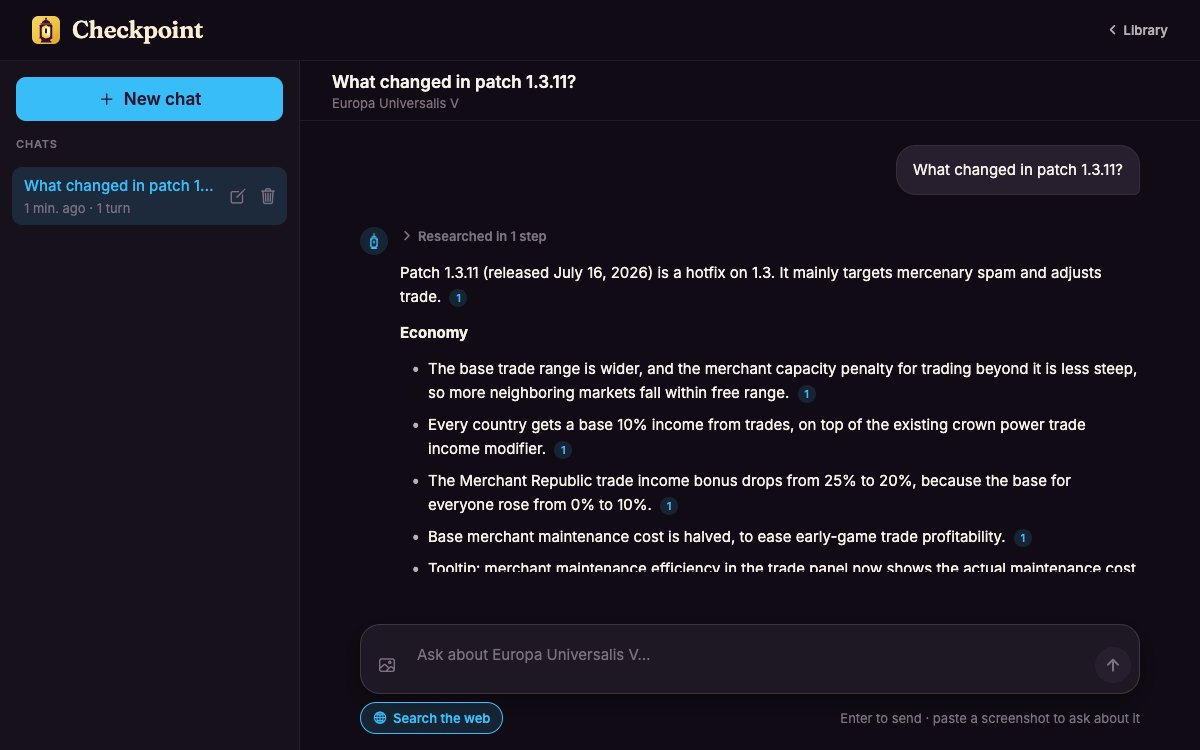
Ask it the way you'd ask a friend who plays. It looks things up, checks what changed, and leads with a straight answer. Then it shows its work.
Patch 1.3.11 cut all trade income by 25% and removed merchant upkeep.
Why it's different
A model can talk about a game. Checkpoint can look things up, and say where they came from.
Items, bosses, laws and buildings are typed entities with attributes and relations. “Which items do X” is a lookup, not a guess.
Every value carries the patches it applies to. Patch notes link to the things they change. Open betas stay apart from the live game.
Structured data first, wiki text second, the web third. An editor pass merges them, and answers say when the web contributed.
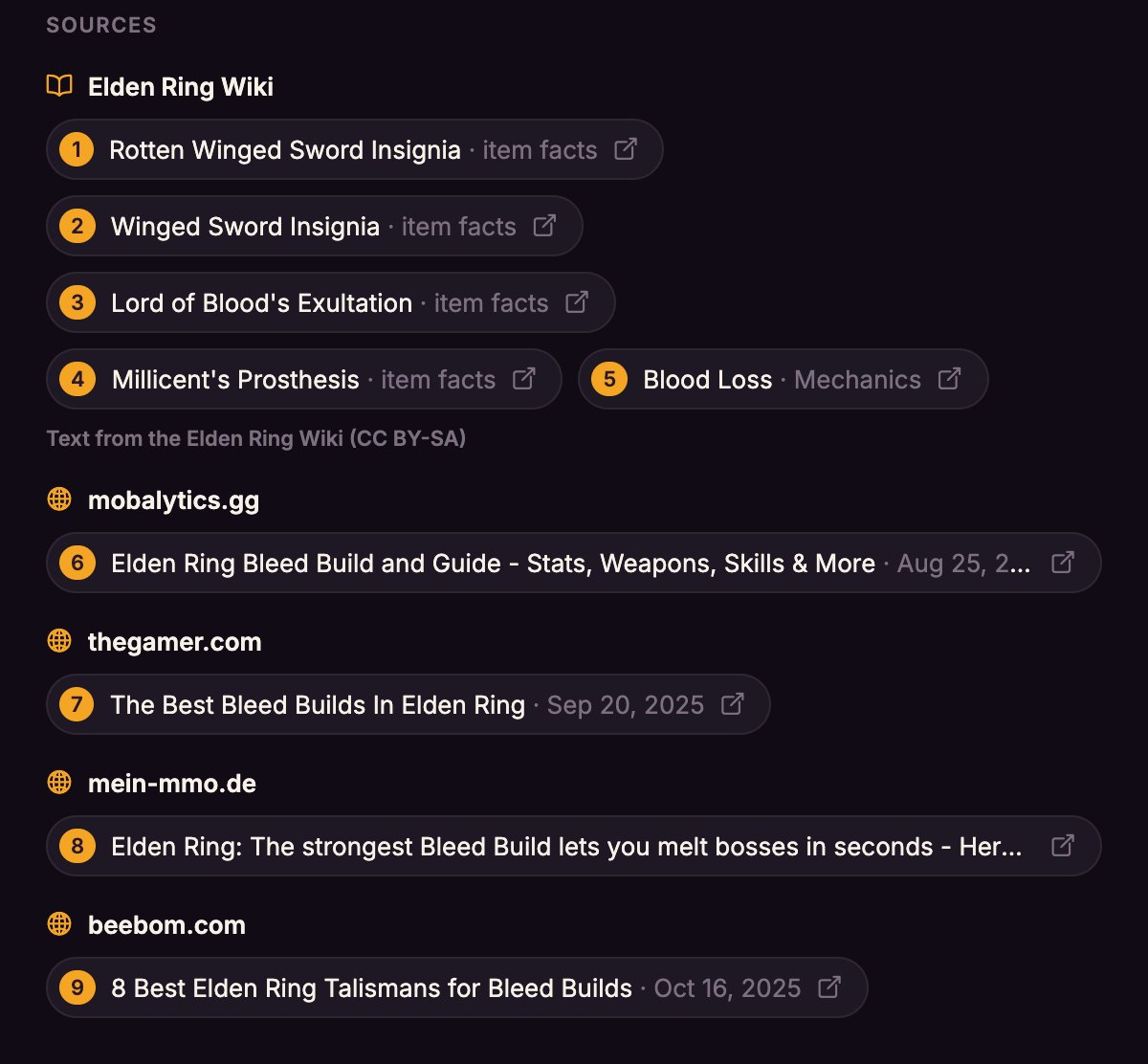
Every claim is cited inline. Sources are listed by name under each answer.
The knowledge base
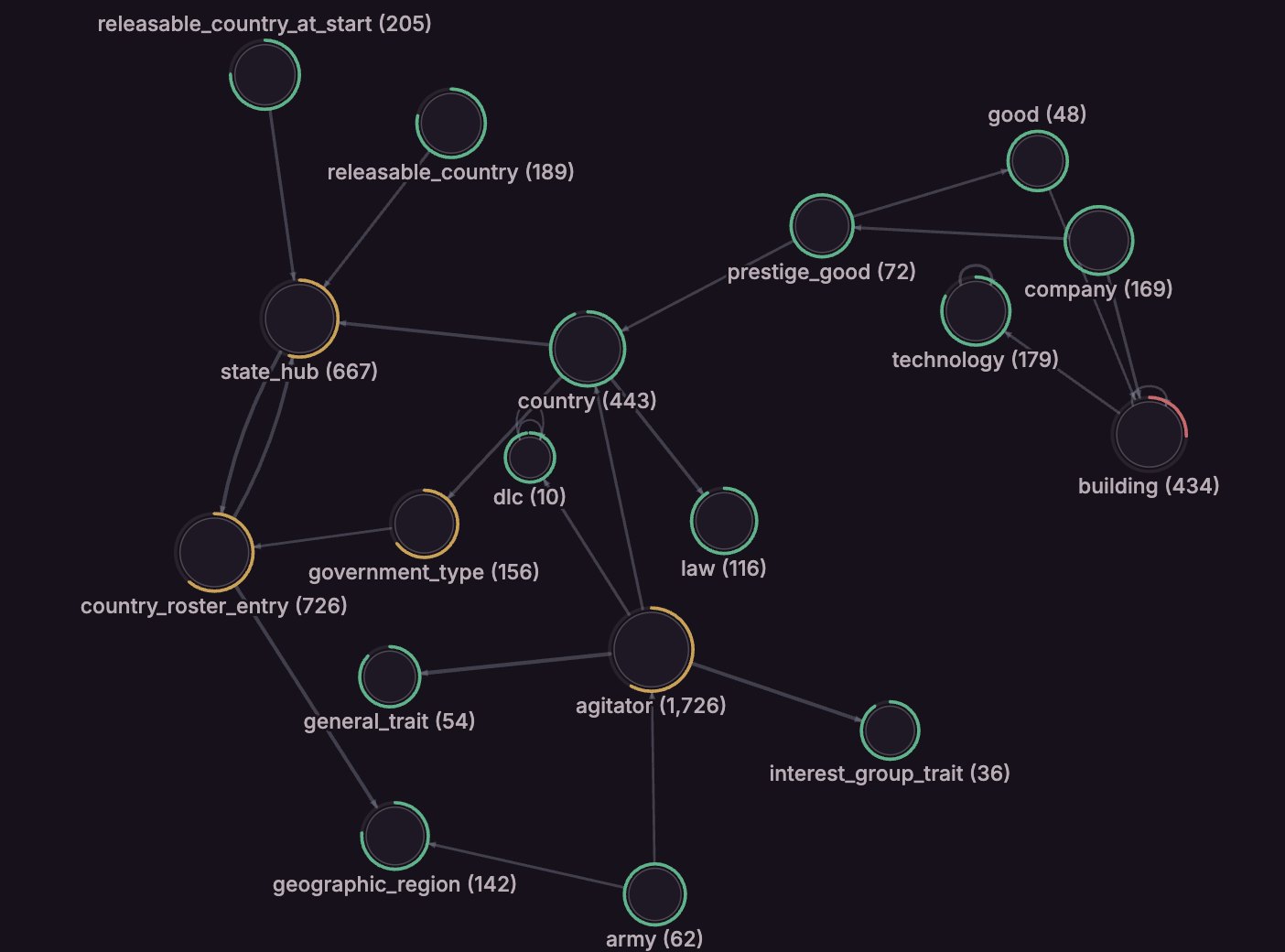
Each game gets its own ontology, designed for how that game works.
Weapons mean one thing in one game and laws mean another in the next. So an architect agent reads how the wiki is organised and designs the entity types, attributes and relations to fit. Values carry patch ranges, so Checkpoint can say what something did before and what it does now.
One attribute, across patches: “Damage bonus” Illustrative
Onboarding
One human approval. Everything after it runs on its own, and every step is recorded.
Agents find the game, scout its wikis and official channels, and audit each source's licence and terms, including AI and text-mining reservations. A person approves the sources. Then agents discover how the wiki is structured, design the ontology, ingest the pages, build the patch history and fill the gaps. A full onboarding costs a few dollars of model spend, so adding the next game is a question of demand, not budget.
Steward and schema agents keep improving it
Agent step Person
A layer that changes itself, safely
Every change to a game's knowledge is traced, versioned and revertible.
The structure is a projection of a versioned spec, so a rollback is exact, not approximate. Each change is attributed to the agent that made it (architect, autoschema, triage, fill, guard, steward) or to a person. When quality checks raise a warning, a steward agent investigates and proposes or applies a fix inside the same guard.
| Version | Made by | Change | Status |
|---|---|---|---|
| v1 | architect | Initial entity types, attributes and relations | Guard passed |
| v2 | autoschema | 15 new types, new attributes | Guard passed |
| v3 | autoschema | Relations, 24 value-link rules | Guard passed |
| v4 | fill | Filled missing attributes | Rolled back to v3answers regressed |
| v5 | steward | Fixed leftover markup in values | Guard passed |
Evaluation
An evaluation system built for a hard question: is this answer actually better, and did the last change help or hurt?
A knowledge base can look healthy while its answers get worse. So Checkpoint is tested from several angles.
A benchmark written the way players ask, in Reddit and Google phrasing, written before any answer is seen. Each game also has its own golden set.
Each question is answered head-to-head against a frontier model with web search and no Checkpoint tools. The bar is better than googling it.
A pairwise judge sees the two answers unlabelled, runs in both orders to cancel position bias, and checks disputed facts with its own web searches.
Models vary from run to run. We estimate that variance, so noise isn't mistaken for progress.
Before a semantic-layer change stands, a guard runs deterministic checks, then a noise-aware eval. Regressions are rolled back automatically.
Data-quality checks run across every value and chunk, every answer keeps a trace of its research steps, and cost is tracked per model.
Credit
Wikis and guides take years of unpaid care. Checkpoint puts them first.
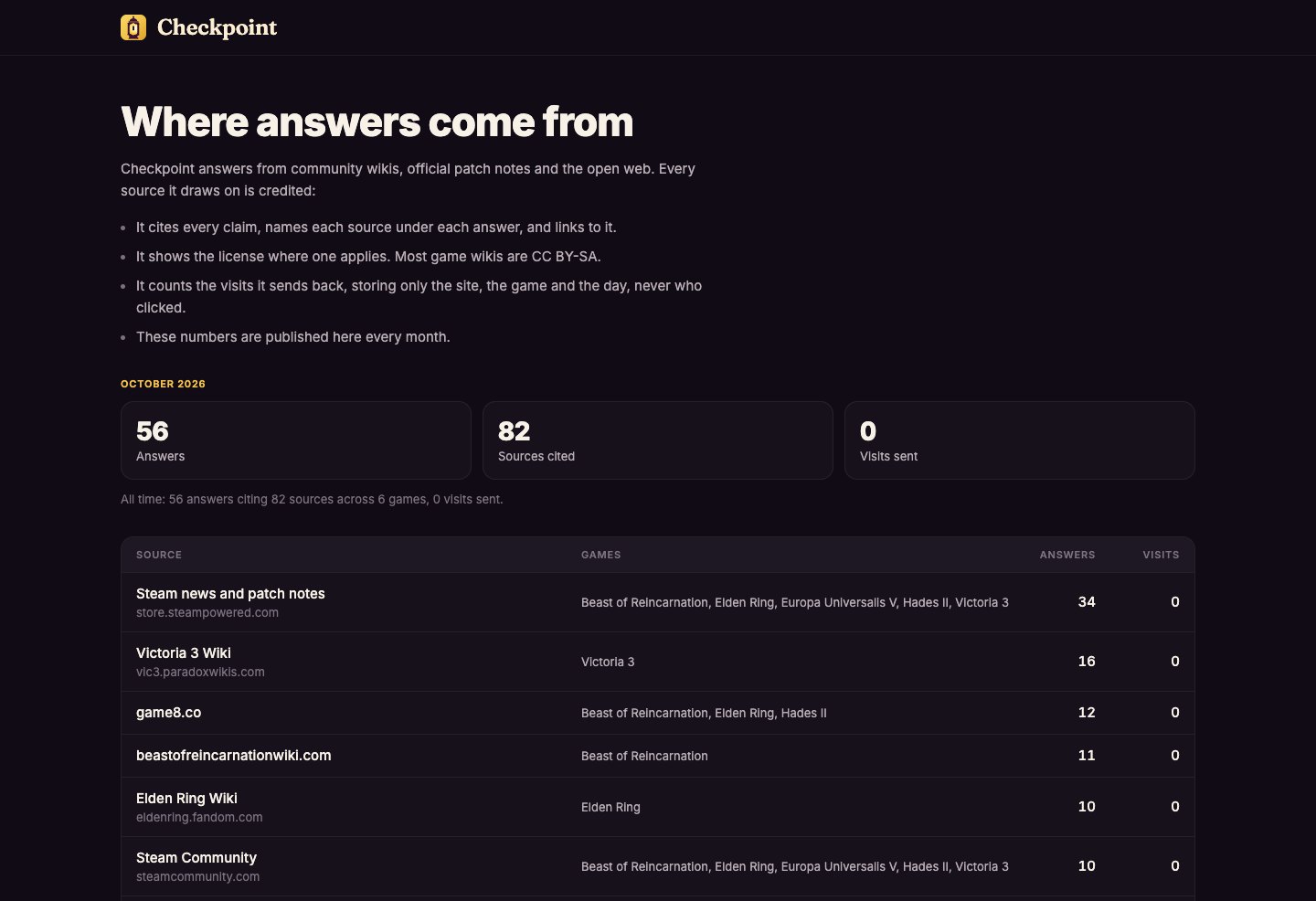
Every answer names its sources and links to the pages used, with licence lines where they apply. A citation ledger counts how often each source is cited and how many answers it fed. Visits are counted anonymously: the site, the game and the day, never who. The numbers are public every month on Where answers come from.
The knowledge is theirs. We say so on every answer.
Sources named and grouped. Wiki text carries its CC BY-SA line.
Licences and AI reservations are audited, and a person approves each source.
When a player flags an error, Checkpoint traces it to the wiki page and drafts a suggested edit for that wiki's editors. A person reviews it first.
Sources claiming themselves and setting their preferences, and, as Checkpoint grows, sharing what it earns with the wikis and creators it relies on. That's our aim; we'll say more when there's something real to share.
Trust and status
No ads. Your data isn't sold. Your chats are private, and you can delete them. Checkpoint runs on cost controls: answers are cached per patch, cheap models handle labelling, and daily spend caps and per-account limits apply. Players can request games from inside the app.
If you run a wiki, write guides, or work at a studio or publisher, write to hello@sidequest.nexus.